Aristotle’s Poetics
A Greek treatise on one sheet, so a class could hold the whole shape of it in their heads before they read a word of it.
Read the poster
Drag to move, scroll or pinch to zoom, or jump straight to a section. It is vector the whole way down, so nothing softens however far in you go. Click any of the nine lit panels and the square I drew for it opens underneath — nine of these went out as a social set, and that part was AI-accelerated.
one of nine squares
3941 × 2550 · one svg file · every mark drawn as a vector path
what is on it
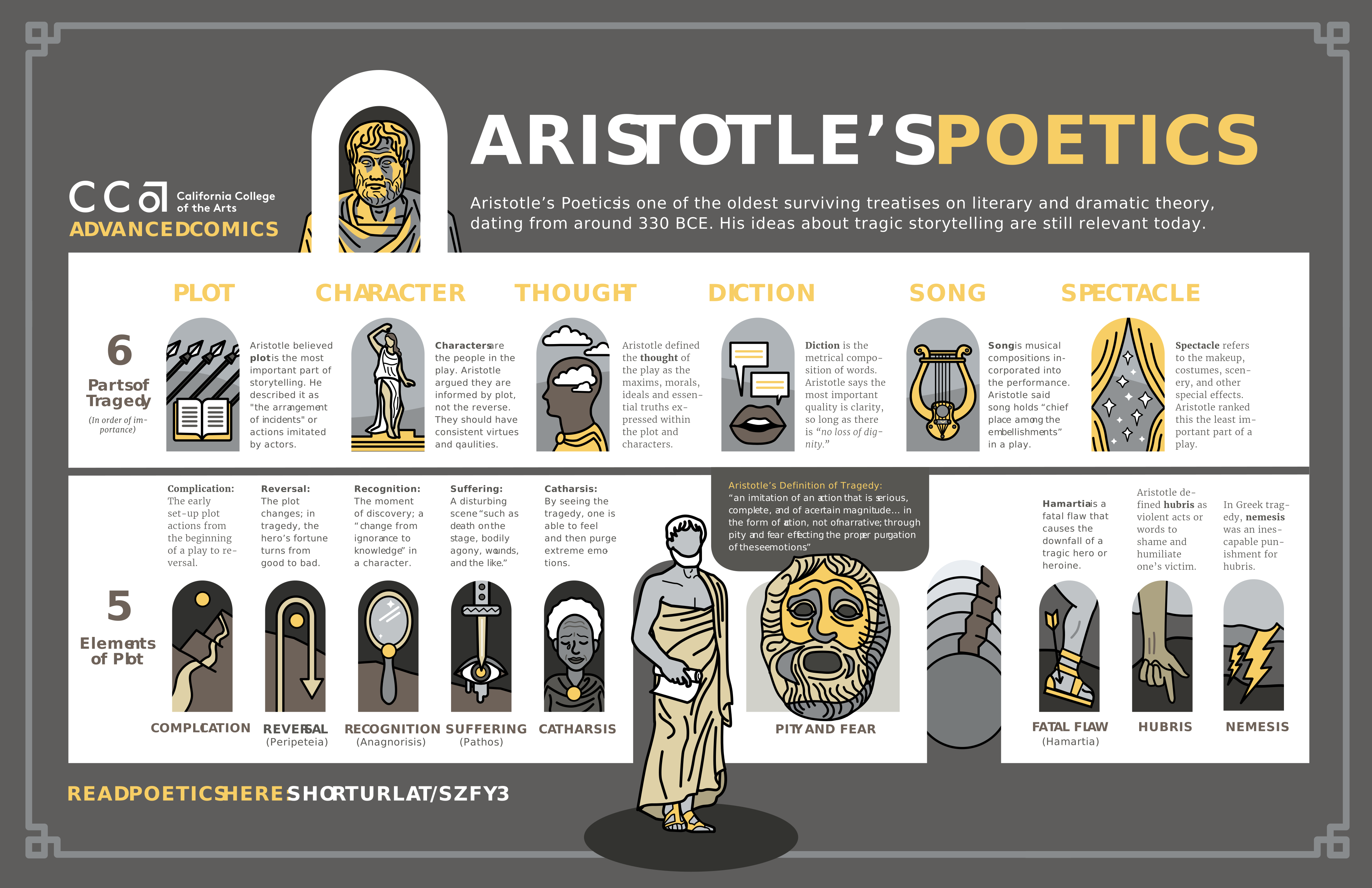
Two bands, in the order Aristotle put them.
- Six parts of tragedy, ranked as he ranked them: plot, character, thought, diction, song, spectacle. Spectacle comes last, which is the part students never expect.
- Five elements of plot: complication, reversal, recognition, suffering, catharsis — each with the Greek beneath it, because the Greek is what turns up in every other book they will read.
- The definition of tragedy quoted in full, and the vocabulary that hangs off it: hamartia, hubris, nemesis.
Every panel pairs a drawing with about forty words. That ratio is the whole design: enough text to be correct, little enough to be read standing up.
how it is built
Drawn in Illustrator. Every figure, icon, border and Greek key is a vector path I drew — no stock, no traced photographs. The palette is three greys, a gold and a white, which is what holds eleven separate illustrations together as one object rather than eleven stickers on a page.
It ships as SVG rather than a flat image on purpose. A JPEG of a poster this dense turns to mush the moment anyone needs to read a panel; an SVG stays sharp at any magnification, which is why the viewer above can take you all the way down to a single word.
Two typefaces do the work: Raleway for the display and labels, Merriweather for reading. Both are subset to only the characters this poster actually uses and embedded in the file, so it renders identically on a machine that has never heard of either font.
why it exists
I taught Advanced Comics at California College of the Arts. The Poetics is on the reading list because it is the oldest surviving account of how stories are put together, and it is genuinely useful to a comics student — but it is a Greek treatise, and asking a studio class to extract a structure from it cold does not work.
So the structure came first, on one sheet, and the reading came second. Students could see the whole shape before they met the prose, and had somewhere to put each part as they hit it.
open to marketing operations, analytics and martech roles
Let’s talk.
Remote, or Albuquerque and hybrid. If you want the architecture behind any of the work here, ask me and I will walk you through it.